Dr. Tom's Corner

Dr. Tom's Corner - Dr. Tom Watschke, Professor Emeritus of Turfgrass Science, Penn State University / Floratine Director of Research

Biostimulants: In Before the Cold GCI Article

December 5, 2011

As Seen in Golf Course Industry December 2011

www.golfcourseindustry.com/bionutrition-111111-tom-watschke-penn-state-turfgrass.aspx

Biostimulants are well-regarded for dealing with summer stress. Dr. Tom Watschke, formerly of Penn State, discusses how they help during the season’s wind-down.

Do biostimulants do anything differently in fall than during other times of the year?

Knowing what we know about biostimulants and managing carbohydrates and looking at plants as they move away from more stressful seasons and toward lower soil temperatures and all the associated environmental stresses, I think one can argue that the principal role isn’t that much different. There could be a difference, of course, in the choices of what one uses. When the soils are heating up, in late spring and summer, they’re essentially in a physiological state when they can’t produce new root growth. That’s where having the biostimulants and carbohydrates make a difference. In the fall, soil temperatures are coming down and biostimulants can aid in the development of new roots.

The most that can be derived from the research with biostimulants is that they’re most impactful when they are applied prior to stresses of any kind. This is pre-stress conditioning philosophy, which is very sound.

If we fast forward then through the summer to the fall and whatever has happened has happened, the positioning of the application of biostimulants is again important prior to the onset of cold temperatures so they’re available before the soil temperatures go significantly down and re-rooting occurs. You want the biostimulants down so they are there when the soil temperature’s low enough to trigger new rooting. Those new roots are going to come out and need to have things in position so they can access it as quickly as possible and have the impact you want to have.

When is the best time to apply biostimulants in the fall?

It really should’ve already been done, if you plot soil temperatures in this latitude, at least. It’s going to peak in late July to early August and then as the days shorten and the direct solar radiation heat load is starting to wane. It should be done by Sept. 1 in most years. This year’s been a bit of an anomaly. My own judgment is when the soil temperature in the upper inch is in the low 70s F for most of the day, things are going to start happening. This year in the Midwest, soil temperatures stayed up in the 80s for a long time – summer just didn’t want to give it up.

What benefits can biostimulants bring during this season?

For the balance of this growing season, their presence will not be that visual because it’s addressing physiological needs. By that, I mean keeping hormones and auxins in balance and storing carbohydrates for winter – we’re talking about physiological changes for winter that we aren’t able to see. The health of the plant is subjected to the kind of physiological status it possesses. The processes that are connected to good growth and health and avoidance of stresses are those things that are helped by biostimulants, things that can be subtle i.e. your fungicide apps might last longer. Not necessarily more clippings in the basket or a deeper green color – the biostimulant is helping make the plant more healthy.

It does, in fact, help next year in the sense that the plants as they progress toward dormancy that have had biostimulant apps do handle winter conditions better and they’re well-positioned in the spring to break dormancy and commence growth.

Invest in Your Root 'Bank' Now!

March 23, 2011

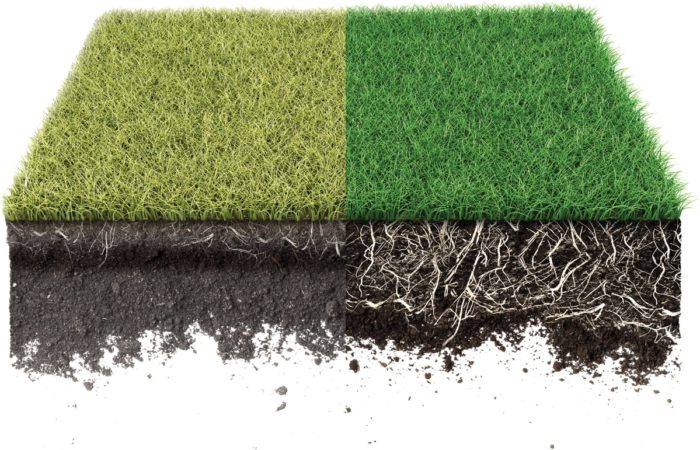
Cool season turfgrasses have cyclical root production throughout the growing season. In the spring when the root zone is cool and moist, cool season grasses produce their maximum amount of root mass for the year. Once the soil temperature gets higher (a result of the radiation heat load that is produced by sun angle and day length), root production slows to the point where much of the root system that has been produced during optimum growing conditions will slough off and end up contributing to soil organic matter content. That is why it is a common observation for cool season grasses that, by mid-summer, the root system is much shorter than earlier in the year. Cool season grasses struggle to produce new roots once the soil temperature has risen, which presents a significant challenge to the golf course superintendent as he/she must adjust irrigation management strategies to accommodate the above ground plant needs for water and nutrients with a limited root system in place to meet those needs.

In the fall, when radiational heat load lessens and the days become shorter, soil temperatures lower and new roots are formed from adventitious buds at the base of the crown. These new roots are highly active in terms of their ability to absorb nutrients and water. It is during this time that cool season grasses flourish and recover from the environmental stress that were encountered during the hot summer months. During the winter, in locations where the soil is frozen for extended periods of time, many of the new roots produced in the fall slough off, much like the sloughage that occurs when the soils get hotter in the summer time. Hence, cool season grasses produce two root systems during the course of the year.

Going into the summer stress period, the best managerial approach for maintaining healthy and active root system, is to help the turf produce as much of a system possible during the late spring root production period (before the soil temperature rises to the point where new root initiation slows significantly). It is much like a bank account, wherein, new root production can be considered to be deposits into the rootzone bank account, while carbohydrate consumption via top growth and elevated respiration rates can be considered as withdrawals from the account. Therefore, the more root system that can be developed, the greater the deposit sum, which will benefit the account when withdrawals exceed deposits.

From a management perspective, anything that can be done to enhance the turf’s ability to grow roots would be a bonus for the account. Cytokinins, for example, have been linked to root growth to a significant degree, so making them available to the turf during ideal root growth periods will provide considerable advantages. Applications of cytokinin containing products well in advance of the production of new roots with continued applications during the optimum rooting period would provide the most beneficial results.

HOT HOT HOT Summer!

September 24, 2010

What a summer it was! Temperature records, rainfall records, the number of days over 90 degrees, etc. from, just west of the Mississippi River, to the Atlantic seaboard. Unusually warm/hot conditions began to occur earlier than normal and the mid-August ‘break’ failed to materialize. Some areas were abnormally hot and dry, where others were abnormally hot and humid with record rainfall (the Chicago area had the second wettest June on record). As a result, superintendents were faced with managing cool season turfgrasses that were suffering from prolonged and excessively rare weather conditions. Well managed and pre-conditioned cool season grasses can survive and persist in inclement weather, but only for so long. Only warm season grasses are able to physiologically adjust and tolerate semi-tropical to tropical weather that plagued much of the Eastern half of the country this season. One could only notice how vigorous and robust the warm season annual grasses (crabgrass, goosegrass, etc.) were this year, even when typically successful control measures were applied.

So now what?

The USGA Green Section and the GCSAA have done a great job of publishing information pertaining to the challenges that have faced superintendents this year. The scope and magnitude of the problems that have been faced and recommended strategies for coping have been very helpful for many.

Finally, the weather has essentially transformed into a more typical early fall mode as the result of the occurrence of shorter days, less radiant heat load, and decreasing soil temperatures. Cool season grasses are producing vibrant new adventitious roots, new basal tillers are sprouting, and new plants are emerging from stolon and rhizome buds. Also, in most areas, the first germination of Poa annua has begun, which will fill in many voids very quickly (like it or not). In areas where high populations of Poa annua were present, there is the possibility to make some gains via over-seeding, but that activity precludes the use of any pre-emergence herbicide for the Poa annua, which becomes a Catch-22.

For many, the need for aggressive renovation of some areas is required and everyone is hoping for a mild and long fall growing season. The weather will turn out to be what ever it is, and nothing can be done about it, except to adapt to any eventuality you might face. One thing is clear, fertility and nutritional management must be the focus during the next few weeks. The need to push growth and enhance grow-in in damaged areas is paramount, but the need to be sure that the turf enters the winter in a hardened condition must not be over-looked.

The best management strategy for nitrogen fertilization during the next few weeks is to maintain as much managerial control as possible. Thus, the use of quickly available nitrogen sources (both foliar and granular) will provide the best control of nitrogen availability and release. Nitrogen must be provided in a consistent fashion to avoid any ‘ups and downs’ in the growth pattern and should not create unnecessary top growth at the expense of root growth and tillering. The availability of nitrogen should also be gradually decreased as the cooler weather of late fall slows growth and the need for winter hardening becomes the nutritional focus.

Obviously, the use of nitrogen sources that can be applied with a true ‘foliar feeding’ approach are preferred because their plant availability and utilization can be controlled. Low rates of application with narrow sequential spacing will work well because such use eliminates the ‘ups and downs’ referred to earlier. Also, the use of foliar materials that contain bio-stimulant compounds should be favored as the recovering turf is in need of hormonal and auxin support for the metabolic processes that facilitate recovery and winter survival.

Good luck with your renovations and recovery this fall and be assured that it is highly unlikely that the 2011 season will be a replica of 2010!

Pre-Stress Conditioning for Improved Turfgrass Health

March 25, 2010

“Dr. Tom’s Corner”

Professor Emeritus of Turfgrass Science, Penn State University

Floratine Director of Academic Research

March, 2010 Issue

There is a lot of buzz in recent months about the PRE-STRESS CONDITIONING of turfgrasses and the importance of managing carbohydrates for improved turfgrass health. These issues are vitally important and have not received enough attention from the turfgrass research community over the years. However, in their defense, funding sources and products that provide the turf with beneficial inputs have both been limited. The time has come to initiate more research projects that are designed to quantify turfgrass responses to products capable of enhancing pre-stress conditioning and separate the ‘wheat from the chaff’ with regard to claims and actual results. Pre-stress conditioning and managing carbohydrates are inter-connected and co-dependent in many ways. Products that enhance the conservation of carbohydrates and support their efficient utilization for various metabolic processes (in cool and warm season species) are the keys for managing turf in a proactive, pre-stress conditioning mode.

By providing turfgrasses with an enhanced ability to build carbohydrates for plant health maintenance prior to the onset of stress (regardless of the type, i. e. mechanical, environmental, nutritional, etc.); the level of stress, when it finally does occur, is not nearly as detrimental to the plant compared to what happens without pre-conditioning.

In 2009, Floratine Products Group (FPG) funded several studies at universities in different geographic locations. Two of these studies (conducted at Virginia Tech and Purdue University) were identical and were designed to evaluate the effect that applications of four FPG products would have on the ability of creeping bentgrass to ‘heal’ following core cultivation. It was determined that the evaluation of mechanical stress was the most ‘controlled’ stress induced phenomenon that could be evaluated. The turf was only treated prior to the core cultivation (pre-stress), and in both studies, the pre-stress applications resulted in turf that was better able to accommodate the mechanical stress, i.e. the holes closed up more quickly and the turf had enhanced quality compared to both the untreated turf and turf that was treated with a nutritional ‘standard’. These results are available on the FPG website along with my summary and interpretation of those results. The reproducibility of the results from two different geographic locations was significant and speaks volumes to the authenticity of the research that was conducted.

In another study conducted at Michigan State University, the issue of enhanced turfgrass health as a result of the applications of FPG products containing bio-stimulants was tested and resulted in better basal anthracnose disease control. Fungicides without FPG products provided acceptable disease control, but the combination of FPG and fungicide resulted in better control and an improvement in overall turf quality. The FPG website has links to this information so that you can print it off and keep it at hand.

The picture is becoming more and clearer that low rates of nitrogen applications (foliar) and the use of products containing bio-stimulants helps the turf become pre-conditioned to an array of stresses (mechanical, environmental, and those associated with disease). This improved ‘plant health’ condition not only helps the turf endure stresses, but any control associated with the application of fungicidal products, increases the efficacy of these materials.

The bottom line is that, controlling growth with judicious and timely nitrogen applications plus keeping NPK in the proper ratio, using the appropriate plant growth regulators at the right time, and making applications of products containing bio-stimulants which enhance many metabolic reactions, provides the turf with an enhanced ability to maintain good carbohydrate levels. Applications using the above strategy also insure that the turf has been pre-conditioned so it can better tolerate stresses when they occur.

As we approach the new growing season in the regions where cool season turfgrasses are the predominate species, it is imperative that a pro-active management style be used. Make applications of those materials that will provide pre-stress conditioning and help in the maintenance of carbohydrate reserves. Have a great season and another issue of Dr. Tom’s Corner will be in front of you in the not too distant future.

My Roots are Disappearing! July 2009

July 20, 2009

“I seem to have reasonable rooting depth by the first of June every year, but by early August, my root depth/mass has diminished significantly.” It comes as no surprise that this is a common refrain during the summer months. And we all know that once we get into that situation alarm bells start ringing. So what can we do?

First, a little perspective. In most locations, cool season turfgrasses lose their roots twice a year (during the hottest months of the summer and during the coldest months of the winter). For most species, peak root production occurs from early May through mid-June in response to cool soil temperatures, good air/water relationships, and available growth materials (carbohydrates). That is the time to prepare for what I will refer to as the ‘marathon’, the upcoming heat and stress of summer that the plant will have to fight through to survive.

New roots are initiated from adventitious buds at the base of the crown, therefore, when conditions are conducive (as described above), root growth is vigorous and prolific. However, as soil temperatures increase and carbohydrates are no longer in abundance, initiation of new roots (our bank account for saving carbs) slows dramatically and older roots become less functional and ultimately slough from the plant and become part of soil organic matter.

As a result, the observation that “my turf has lost its roots” is accurate. This obviously adds to the superintendent’s own summer stress level as we move into the stressful summer months and your grass plant has to run the aforementioned marathon with little in reserve. Therefore it is in our best interests to prepare the turf accordingly.

Now we are at the time of the year with heat and humidity, and good or bad, we now need to be ‘reactive’ and help our turf cross the proverbial finish line!

It is much like managing a bank account, in the sense that, when things are going good, deposits to the bank account / roots (carbohydrates) can be increased knowing that when withdrawals begin to exceed deposits, there is a source of reserve to draw from in order to better tolerate environmental stresses and to maintain the best root system possible.

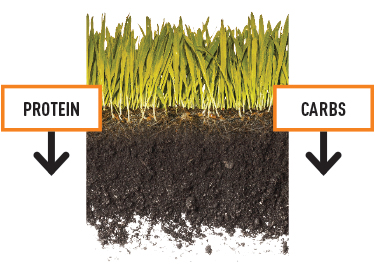
However, once the temperature (both soil and air) exceeds that which allows the turf to easily provide carbohydrates, the turf will become physiologically stressed and less able to meet the daily demand for carbohydrates. Once the turf has reached that point, needed carbohydrate can only be supplied by that which is in reserve (the roots) or via supplemental feeding. It is obvious that if your roots are disappearing, the plant is going to have a difficult task of absorbing nutrients from the soil. Foliar feeding, which bypasses the root system, offers a very effective means to help the plant through times of stress, basically, helping the plant through the marathon, much like a runner’s glyco-gel packs and sports drinks help them finish those punishing races.

Nitrogen sources that are soluble provide the best managerial control of N release and facilitate the proper timing for sequential applications. Properly balanced Bio-stimulant products that contain gibberellins, cytokinins, auxins, and/or other organic compounds (derived from various sources) are valuable for providing growth materials without over stimulation. Foliar sources of essential amino acids and complex sugars will assist the turf when the conditions for growth are less than optimal. The whole goal is to help the plant work as little as possible to manufacture the carbohydrates it needs to survive and foliar feeding can do that very effectively.

Once soil temperatures begin to decrease (usually in late August) the turf will begin to produce new roots, but never as prolifically as in the spring (primarily because the days are getting shorter and the level of radiant energy being received is lessening).

The bottom line is that by properly managing carbohydrates, the more likely it is that your turf can maintain root growth longer, slough less, and be more tolerant of environmental stresses. The same holds true when the stresses of summer hit, as the superintendent now has tools to supplement the plant’s nutritional needs to help his turf efficiently produce the carbohydrates that will help it survive during the actual “marathon.”

Until next time, Dr. Tom hopes that the summer stresses to you and your turf will be minimized and September will be here before you know it!

Thoughts on Plant Growth Regulators March 2009

March 12, 2009

As I travel around the world speaking to superintendents, I am often asked what the effects, if any, biostimulant products have on the efficacy of the plant growth regulators such as Primo.

For the most part, biostimulant products are quite compatible with turf growth regulators. Considerable research has been conducted over the recent years evaluating this very issue. If anything, the inclusion of biostimulant products with turf growth regulators tends to enhance the activity of the growth regulator. Research at Penn State has shown that the efficacy of Primo Maxx can be increased with the addition of certain biostimulants (to the extent that half rates can mimic the growth suppression attained when a full rate is applied without the added biostimulant).

There is some question amongst golf course superintendents with regard to whether or not biostimulant products that contain some gibberelin (GA) might compromise the efficacy of turf growth regulators that inhibit the biosynthesis of GA. The question is primarily couched in the knowledge that turf growth regulators that inhibit the biosynthesis of GA can be antidoted with applications of gibberelin. While this antidote phenomenon is essentially true, the rate of applied gibberelin used to accomplish this response would have to be very high (usually in the range of 5 grams per acre). No biostimulant product has anywhere near that concentration of GA. When field trials have been conducted to determine whether biostimulant products containing GA do, in fact, comprise the growth suppression capability of GA inhibiting growth regulators, no significant evidence has been documented that such a situation exists. That being said, it should be clear that using biostimulants containing GA at rates higher than recommended on the label or at shorter intervals than recommended, could bring about a different result than what has been found. Attached is a study conducted by Syngenta that looked at the use of plant growth regulator,Primo MAXX , with the biostimulant product, Astron. The outcomes of this study show that “Astron does not appear to have significant affect on the growth regulation characteristics of Primo MAXX when applied at rates set out in this trial.”

Another issue, particularly pertaining to the use of Primo Maxx, is that superintendents that have used the product for several years for managing clippings (primarily on fairways) are frustrated that the degree and longevity of suppression decreases over time. Often the using biostimulants that contain GA are blamed for this gradual loss of efficacy from Primo Maxx applications. The more likely scenario is, that over time, since Primo Maxx applications enhance the competitiveness of Poa annua, the stand of Poa annua being treated undergoes a population shift in the direction of increased numbers of aggressive perennial ecotypes. As a result, the ability to suppress growth by applying Primo Maxx at the same rates and timings as originally used, no longer provides the same level of growth suppression (which necessitates higher rates/shorter application intervals). Such a result is certainly not a bad thing, but must be understood in the proper context using turf growth regulators for clipping management.

Until next time, Dr. Tom wishes you a winter season filled with educational opportunities so go out and indulge yourself!

Biostimulants October 2008

October 1, 2008

Question: Dr. Tom, Are biostimulants for real? And if so, what are they and should I use them?

Dr. Tom: Many superintendents seem to have questions surrounding biostimulants. There appears to be some confusion and / or skepticism in the field surrounding the subject. Some superintendents were exposed to them in school while others may have little to no exposure to the topic.

“Answers to Some Questions Golf Course Superintendents Have Concerning the Use of Biostimulants”

To answer your first question, YES! They are very much ‘real!’ And they have been researched for some time. There is a very nice paper that I would recommend you reading on the subject. It is by R.E. Schmidt and E.H. Ervin, Professor Emeritus and Assistant Professor, respectively, Turfgrass Ecology and Physiology, Virginia Polytechnic Institute.

In this paper, they say “Our research has documented that applications of (biostimulants) have conditioned turfgrasses to tolerate environmental stresses and improve grass growth, particularly root development.” From my experience and based on my colleagues research, I can say again, yes, biostimulants are for real.

To your second question, ‘what are they?’, in very simple terms and as the aforementioned paper highlights biostimulant properties can be found in seaweed extracts, humic acids, and triazole fungicides among others. While the content of each varies, research shows that seaweed and humic acid are two the most commonly used biologically active ingredients, and even then the sources of each need to be examined closely.

Most relevant to you as a superintendent managing turf in very demanding conditions, Schmidt and Ervin state “Biostimulants enhance plant metabolic activity to condition the plant to tolerate stresses. Therefore biostimulants have a greater impact when applied prior to the turf being subjected to anticipated stress.” This is obviously something you need to consider when planning your turf nutrition program. Biostimulants should be viewed as a proactive step in managing healthy turf as Professors Schmidt and Ervin point out: “… better results are obtained when sequential treatments are made and the second year is better than the first. Monthly applications prior to and during the stress periods (three to six applications per year) should be programmed....”

As managers of ‘extremely maintained’ turfgrass , you face myriad stresses along with your turfgrass! There are cultural practices and environmental pressures that put extreme stress on your turf. There are budgetary and player demands that put extreme stress on you. I am a proponent of ‘getting ahead of the curve’ through proactive nutrition practices instead of getting caught in ‘reactive’ mode. I think biostimulants, as part of a comprehensive turf nutrition program, can go a long way in helping superintendents relieve two stresses: their turf’s and theirs!

Until next time, Dr. Tom wishes you strong root mass and safe travels!!